While a lot of health and safety is common sense it is important when working on film productions as sometimes just common sense can struggle to prevail on a film set when people start rushing due to it getting dark, weather closing in or people getting tired. Therefore, health and safety procedures can try and reduce the risk of incidents occurring, which is important as even if someone can see the potential of an accident and does nothing about it, they can be held responsible in some way. Because of this it is important to complete a risk assessment as by pre-empting accidents, you will be able to reduce the risk of them happening, before they even occur.
Also, while on a film set, simple tasks such as just running down a hill can become dangerous as the actors may have to do this repeatedly to get the scene right, this therefore means that the chance of the tripping and falling on their face is increased every time this is done.
One key safety issue regarding film production is weather. This is because some film shoots may be taking place outside all day, therefore meaning it is important that the crew and actors are dressed appropriately to protect them from getting cold, or to prevent sun stoke.
Also, there is normally quite a lot of time pressure to try and finish filming, which means that people may start to take risks, and hazards begin to be overlooked. Therefore it is important to try and calm people down, and reduce the pressure on set.
Some other common safety issues in film production, and ways they can be reduced are: reduce tripping hazards by moving or taping down cables or moving objects in the way, be careful when lifting something and get help, if a camera operator has to walk to achieve a certain shot, making sure they are comfortable doing this and being careful when filming around water or at heights. For example, if a section of the risk assessment concerned being careful when filming around water, the risk of doing this could firstly be assessed, such as equipment falling into water, and therefore being water damaged, or even crew falling into water, and potentially drowning. Now while these risks may have a low chance of occurring, the consequence of it happening would be very high, and therefore you would list ways of preventing the hazard from happening, such as making sure trained life guards are present while filming, electrical equipment is kept as far away as possible from water, and to make sure cameras, and other such equipment is waterproofed if possible.
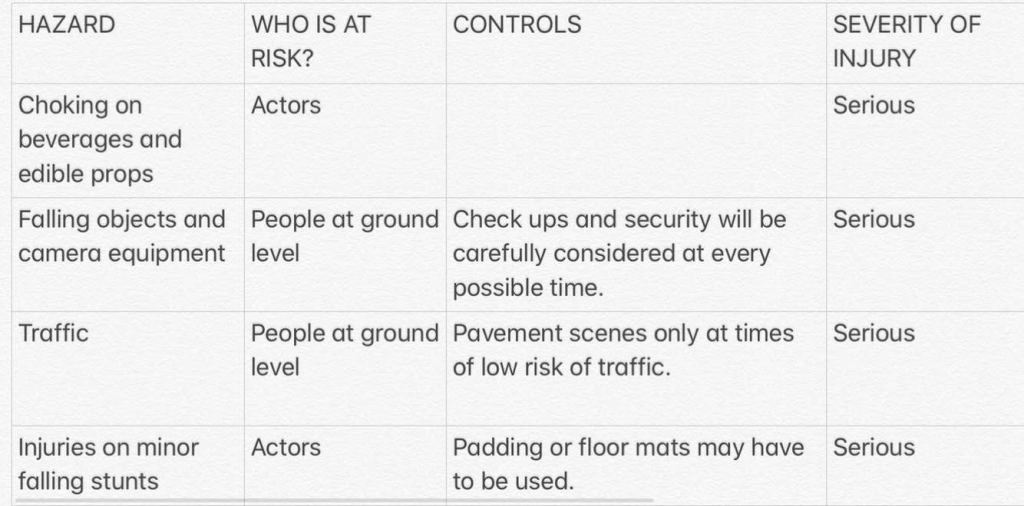
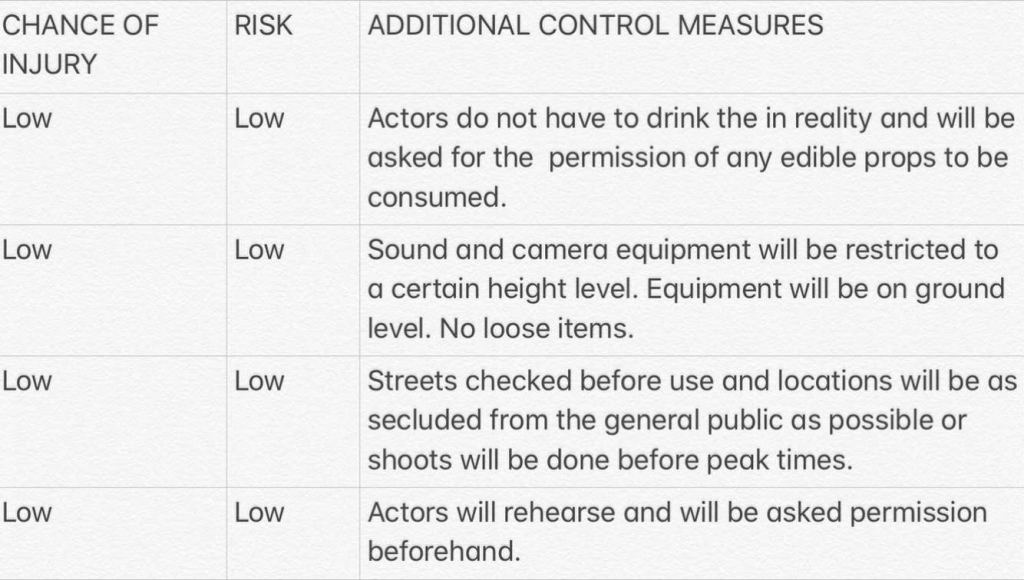
One way our group applied good health and safety practice was by the producer completing a risk assessment. This allowed us to see the potential hazards which could occur when shooting our film, who would be at risk, the severity of injury, the chance of it occurring and the controls we could put in place to reduce to reduce the risk occurring. By doing this risk assessment it meant we were more aware of the possibility of a hazard, which meant we were more careful during filming.
When on location one way I improved health and safety was by trying to reduce the amount of wires on the floor. My role on the day was capturing sound, which is a role which involves using equipment such as boom microphones that use a lot of wires to connect the microphone to the camera. Because of this I made sure to wrap the cable around the boom mic to make sure no wires were left on the floor, stopping someone possibly tripping over it and falling.
 BFI Film Academy
You’re correct in saying a lot of the Health and Safety your team will specifically be dealing with is common sense, but even for low level risks it’s vital to do a risk assessment! By pre-empting accidents, you can eradicate them before they have the chance to happen. Would you be able to include a print screen or scanned image of your team’s Risk Assessment? It’s the job of the Producer to fill this in, but any of you can raise a safety concern to be investigated in the risk assessment. You mention being careful when filming around water and heights — how specifically would you assess these risks and prevent injury within your team and damage to equipment? I understand that you have not yet started shooting your short film, but if you could pre-emptively discuss specific issues you could face when making your short film at the BFI Academy — whether that pertains to set, props, equipment, etc — that would get you a top level answer.
LikeLike
Hi Michael,
Thanks for updating this answer with a copy of your Risk Assessment, that’s really useful!
Giving practical examples of how you have ensured safe working (such as wrapping the cable around the boom pole, as you mentioned) demonstrates that you understand the need for safe working while using equipment and can carry out safe working practices in your own filmmaking process. Having returned to this module after you made your short film, you have been able to discuss retrospectively the way assessing Health and Safety before the creation of your film helped to ensure a smooth process with minimal accidents on the shoot day. Good stuff.
Nora
LikeLike